
Piles or fissure? How to tell the difference
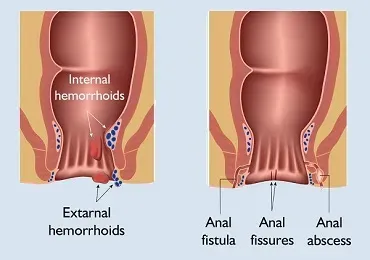
Most people who come to a proctology clinic have already decided what they have. Nine times out of ten they say “piles”. Often it is not.
The distinction matters, because the two conditions are treated quite differently, and because a third group of causes — the ones nobody wants to think about — can look like either.
The single most useful question: does it hurt?
This one question separates the two conditions more reliably than anything else.
Internal piles usually do not hurt. They bleed. The blood is bright red, appears on the paper or in the pan rather than mixed into the stool, and the whole episode is painless. Internal piles sit above a point in the anal canal where there are very few pain-sensing nerves, which is why a pile can bleed considerably and still not hurt.
A fissure hurts, sharply. People describe it as passing broken glass. The pain comes during the bowel movement and then continues — sometimes for minutes, sometimes hours afterwards. Bleeding is usually a small streak, much less than with piles.
If someone tells me the pain lasts an hour after going to the toilet, I am thinking fissure before I have examined anything.
What each one typically looks like
| Piles | Fissure | |
|---|---|---|
| Pain | Usually none | Sharp, during and after |
| Bleeding | Often more, bright red | Usually a streak |
| Lump | Common, may prolapse | Sometimes a small skin tag |
| Itching | Common | Less common |
| Duration of pain | — | Minutes to hours after |
When piles do hurt
There is an exception worth knowing, because it frightens people.
An external pile can develop a clot inside it — a thrombosed pile. This produces sudden, severe pain and a firm, tender, bluish lump at the anal opening. It comes on over hours, not days.
It is not dangerous, but it is genuinely painful, and it is worth being seen promptly because the treatment is much more effective in the first couple of days.
The cycle that keeps a fissure going
Fissures are self-perpetuating, which is why they so often fail to settle on their own:
- A hard stool tears the anal lining
- The tear causes intense pain
- Pain makes the anal muscle spasm
- Spasm reduces blood flow to the area
- Poor blood flow prevents healing
- Fear of the pain delays the next visit to the toilet
- Stool hardens further, and re-tears the same spot
Any treatment that only addresses the pain leaves this loop running. Effective treatment breaks it in more than one place at once — softening the stool and relieving the spasm.
What you should not self-diagnose
Here is the part that matters most, and the reason I would rather people came in than looked it up.
Rectal bleeding has causes other than piles and fissures — polyps, inflammatory bowel disease, and colorectal cancer among them. These are not reliably distinguishable from piles by symptoms alone. A pile can bleed exactly the way something serious bleeds.
Please be seen without delay if you have:
- Blood that is dark, or mixed through the stool rather than on its surface
- A persistent change in your bowel habit
- Weight loss you did not intend
- Bleeding and you are over 40
- A family history of bowel cancer
- Bleeding that does not settle with treatment
None of this means you have something serious. The great majority of rectal bleeding is benign. But the only way to know is an examination, and it takes a few minutes.
What treatment usually looks like
For fissures, most people never need surgery. Correcting the constipation properly, relieving the sphincter spasm, warm sitz baths and local treatment will heal the large majority. Chronic fissures that have failed proper conservative treatment are a different conversation — but that conversation comes after weeks of treatment, not at the first visit.
For piles, treatment follows the grade. First- and second-degree piles usually respond to medication and dietary correction. More advanced piles may need a procedure — Kshara Karma, or conventional surgery where the disease warrants it.
In both cases, the part people skip is the bowel habit. The pile or the tear is the symptom; straining is usually the cause. Treating one without the other is why so many people find the problem returns.
If any of this sounds like what you are experiencing, an examination settles it quickly. Read more about piles and anal fissure, or book a consultation.