
Panchakarma
"Ayurvedo amrithanam" — Ayurveda is the nectar of life
Overview
Panchakarma means “five actions”. It is the classical Ayurvedic system of therapeutic purification — removing accumulated metabolic waste and restoring the balance of the three doshas (Vata, Pitta and Kapha) rather than simply suppressing symptoms.
According to Ayurveda, every person is a unique combination of the five elements: ether, air, fire, water and earth. Vata combines ether and air, Pitta combines fire and water, and Kapha combines water and earth. These three are the tridosha, and illness is understood as their disturbance.
Panchakarma is prescribed to a person, not to a diagnosis. Two people with the same complaint may need different procedures, which is why every course here begins with an assessment by a doctor.
The three stages
Most people picture only the middle stage. The stages either side are what make it work, and skipping them is the usual reason a course disappoints.
1. Purva Karma — preparation
- Snehana — internal and external oleation with medicated ghee or oils, over several days, to mobilise waste from the tissues
- Swedana — controlled therapeutic sweating, which loosens what oleation has mobilised
2. Pradhana Karma — the main procedure
One or more of the five actions, chosen for your condition.
3. Paschat Karma — after care
- Samsarjana Krama — a staged return to normal diet, starting with thin gruel
- Rest, and a defined daily routine
- Follow-up review, and medication where needed
The five procedures
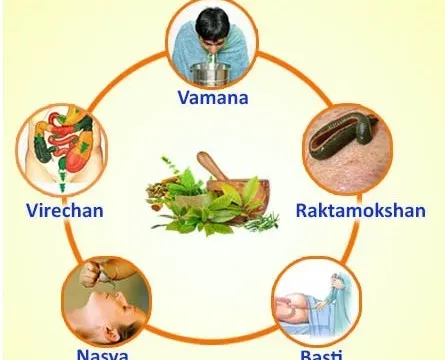
- Vamana — therapeutic emesis. Primarily for Kapha disorders: bronchial asthma, chronic sinusitis, some skin conditions
- Virechana — therapeutic purgation. Primarily for Pitta disorders: skin disease, liver and digestive conditions, some inflammatory states
- Basti — medicated enema, considered the single most important procedure. Primarily for Vata disorders: back pain, sciatica, arthritis, neurological conditions
- Nasya — nasal administration of medication. For conditions above the collarbone: sinusitis, migraine, cervical spondylosis
- Rakta Mokshana — therapeutic bloodletting. For localised blood-related conditions
Conditions we commonly treat
Panchakarma is not a cure-all, and we would rather be specific than sweeping. It is most often used here for:
- Chronic back pain, sciatica and cervical spondylosis
- Osteoarthritis and rheumatoid arthritis
- Psoriasis, eczema and chronic urticaria
- Bronchial asthma and chronic sinusitis
- Migraine and chronic headache
- Digestive disorders including IBS
- Stress, insomnia and fatigue states
- Obesity and metabolic syndrome, alongside diet and lifestyle correction
For several of these, Panchakarma works best alongside conventional treatment rather than instead of it. If you are on medication for a diagnosed condition, bring the details — we do not ask patients to stop prescribed treatment in order to start here.
Therapies offered
- Abhyangam
- Pizichil
- Udwartana
- Utsadanam
- Swedam
- Dhanyamla dhara
- Kashaya dhara
- Thaila dharam
- Takra dhara
- Lepam
- Avagaha sweda
- Navara kizi
- Elakkizi
- Pottikizi
- Kativasthi
- Greeva vasthi
- Prishta vasthi
- Janu vasthi
- Shiro dhara
- Vamanam
- Sadyo vamanam
- Classical vamanam
- Virechanam
- Sadyo virechanam
- Classical virechanam
- Vasthi
- Uttara vasthi
- Nasyam
- Raktha mokshanam
- Agnikarma
- Akshi (nethra) tarpana
- Karna puranam
Wellness and rejuvenation
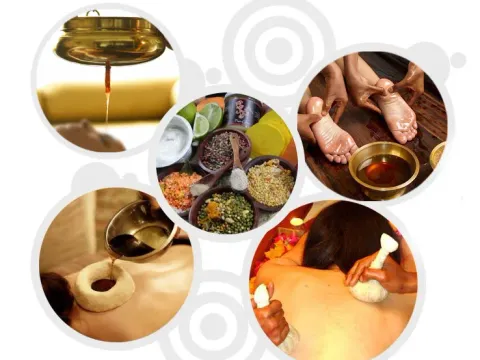
Alongside classical therapeutic Panchakarma, we offer a contemporary blend focused on relaxation, mindfulness, energy, skin and hair — what we call an indo-west blend (Ayurveda, Swedish, Thai and aroma techniques).
Wellness packages — obesity, hypertension, diabetic, skincare, hair care, joint care
Rejuvenation — head-to-toe wedding rejuvenation, regular rejuvenation, geriatric rejuvenation, women’s and men’s fitness programmes
Pregnancy and well-baby, with home services available — pregnancy care, post-delivery care, baby care
What to expect here
All treatments are given by trained therapists and monitored by our doctors. We have well-equipped treatment rooms, and experienced staff for patients who need more care — elderly, children, pregnant and post-delivery patients, and the seriously unwell. Home care is available where travelling daily is difficult.
You will be given a written schedule and estimate before starting, so you know the number of days, the procedures involved and the cost in advance.
Frequently asked questions
How long does Panchakarma take?
It depends on which procedures you need and why. A focused, single-procedure course may run 7 to 14 days. A full classical Panchakarma including preparation and the post-treatment diet regimen typically runs 21 to 28 days. Wellness and rejuvenation packages can be as short as 3 to 7 days. We give you a defined schedule after assessment rather than an open-ended course.
How much does Panchakarma cost in Bangalore?
Cost varies with the procedures involved, the duration and whether you stay in or attend daily as an outpatient. Because the plan is built around your assessment, we do not publish a single figure — you receive a written estimate covering the full course before treatment starts, so there are no additions partway through.
Is Panchakarma just a massage or a spa treatment?
No. Abhyanga (oil massage) is one preparatory step, and it is the part most spas borrow. Panchakarma proper is a medical intervention involving controlled therapeutic purification, prescribed and monitored by a doctor, with a specific diet and rest regimen around it. It has genuine contraindications. A spa treatment does not.
Do I need to take leave from work?
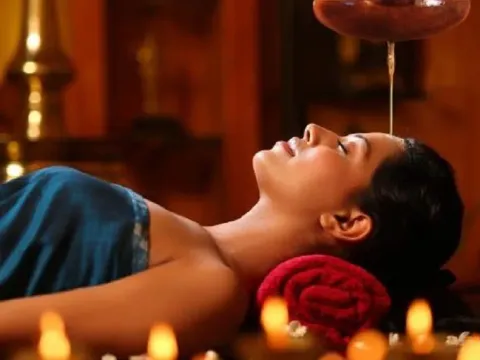
For the main purification procedures — Vamana and Virechana in particular — yes, you should plan to rest that day and often the following one. Other procedures such as Basti, Abhyanga or Shirodhara can usually be taken around a working day. We will tell you which days need to be clear when we set your schedule.
Who should not have Panchakarma?
The purification procedures are not appropriate for everyone. Pregnancy, very young children, frail elderly patients, uncontrolled diabetes or hypertension, active infection, recent surgery and certain heart conditions all need careful assessment, and some rule out particular procedures entirely. This is exactly why it is prescribed after examination rather than chosen from a menu.
What is the diet during Panchakarma?
A specific, staged diet is part of the treatment, not an optional extra. During preparation you take progressively lighter food. Immediately after the main procedure you follow a graduated regimen called Samsarjana Krama, beginning with thin gruel and building back to normal food over several days. Skipping this is the most common reason people feel the results do not hold.
Medically reviewed by Dr. Shashidhara G., BAMS, MD(Ayurveda) & VSF · Reg. 13023 KAUP Board · Last reviewed
Panchakarma consultation
Tap the Book appointment button on this page to request a slot online — we confirm every booking by phone. Prefer to talk to someone now? Call or message us directly.
All Days 10:00am to 9:00pm